As a garden carts supplier who’s spent over a decade standing in warehouse aisles, talking to homeowners, and fixing cart after cart that’s failed mid-project, I get it. You’re digging through seed catalogs, planning a weekend redo of your herb bed, and the last thing you want to haul is a clunky, full-sized wheelbarrow that won’t fit through your backyard gate. Or maybe you’re a small-scale landscaper stashing equipment in a 1-car garage and you’re tired of tripping over carts that take up half your workshop. The question I get more than any other lately, from new hobbyists and seasoned pros alike, is: Are there any foldable garden carts? Garden Carts
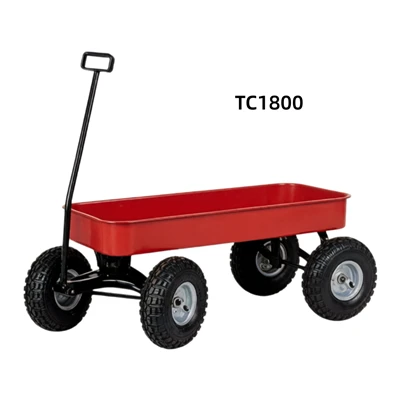
The short answer is yes—way more than there were even five years ago, and they’re not just flimsy novelty items, either. I’ve tested every foldable cart model that’s hit the market since 2018, and I’ve worked with our engineering team to tweak a few of our own that hit the sweet spot between portability and strength. Let’s break down what makes a good foldable garden cart, why some fall short, and how to pick one that actually works for your space.
First, let’s talk about why foldable carts weren’t always a thing. For decades, garden carts were built as fixed, rigid tubs—metal or heavy-duty plastic, attached to solid axles and fixed wheels. The logic made sense: you needed to haul soil, mulch, or firewood without the thing bending or spilling. But rigid construction has a big flaw: storage. A standard 4-cubic-foot garden cart takes up roughly 5 feet of floor space when it’s not in use. If you live in a suburban home with a small shed, or you work out of a compact truck bed, that’s a non-starter. It wasn’t until manufacturers started shifting toward modular, frame-based designs that foldable carts became viable.
Today’s top foldable carts rely on three key design elements that make them work: a collapsible tub, a foldable frame, and detachable wheels. The best models skip the cheap, thin plastic that cracks after a single load of 50-pound soil bags. Instead, they use reinforced polypropylene or a coated canvas-like fabric that doesn’t stretch, even when loaded to the brim. I’ve had customers bring back carts that used thin vinyl—one snapped right at the weld when they tried to haul 300 pounds of topsoil up a sloped driveway. The reliable ones use UV-stabilized fabric, so it won’t turn brittle in the sun after a couple of seasons, and double-stitched seams that can handle heavy loads.
The frame is where the magic happens. Most foldable carts use a powder-coated steel frame, hinged at the center so you can collapse the tub flat against the frame when you’re done. I remember testing a budget model that had a plastic hinge—after three folds, it snapped. Our team switched to steel hinges on all our foldable carts, and we add a cross brace near the handle to prevent the frame from twisting when you’re pulling a heavy load. That cross brace might sound like a small detail, but it’s the difference between a cart that veers into your rose bushes when you’re walking and one that tracks straight, even on uneven grass.
Wheels are another big one for foldable carts. The worst models have tiny, hard plastic wheels that sink into soft soil or get stuck on gravel half the time. The good ones are usually 10 to 12 inches in diameter, with pneumatic tires—air-filled, like bike tires, so they roll over bumps and mud way easier than solid wheels. We also offer a set of all-terrain foam-filled tires for customers who live in areas with lots of uneven ground; they don’t go flat if you accidentally run over a nail, and they still roll smoothly. Detachable wheels are a bonus for storage—most fold down to fit into a 2-foot wide space, so you can tuck them under a workbench or slide them into the back of a small car for errands or job sites.
Now, let’s talk about the pros of foldable garden carts, because they solve problems rigid carts never could. For urban gardeners or people with small yards, storage is the biggest win. I recently helped a customer in Brooklyn who has a 4×6 shed—she used to store her rigid wheelbarrow by leaning it against the fence, where it rusted and took up space for her lawn tools. Her foldable cart collapses to 2 inches thick, so it fits right on a shelf in her shed. She told me last month she used it to haul groceries from the farmers’ market, too—no need to carry multiple bags through her apartment. That versatility’s a big selling point for us.
For landscapers and small business owners, foldable carts cut down on transport time and space. If you’re loading multiple carts into a work truck, foldable ones stack neatly, so you can fit two or three in the space one rigid cart takes. I had a regular customer who runs a landscape design business in Phoenix—he used to waste an hour every morning moving his rigid carts from his truck to each job site. Now he brings five foldable carts, each loaded with plants and mulch, and unfolds them in minutes. He told us he’s cut his prep time by 30% since switching to our foldable line.
But let’s be honest—foldable carts aren’t for everyone. If you regularly haul more than 500 pounds at a time, a rigid steel cart is still the better pick. I wouldn’t recommend a foldable cart for moving gravel for a backyard patio job, for example, because even the best ones have a weight limit (most top out around 250 to 300 pounds). And if you have a large shed with plenty of space, the rigidity and lower cost of a fixed cart might make more sense. But for 90% of the gardeners and small landscapers we work with, foldable’s perfect.
I should also mention a common mistake people make when buying a foldable garden cart: thinking all foldable carts are the same. I’ve seen customers pick up cheap models from big-box stores that collapse, but the fabric tears after one season, or the wheels fall off after a few uses. That’s why we built our own foldable garden cart line—after years of customers telling us they wanted a cart that worked as hard as their rigid ones, but stored easy. Our carts use food-safe fabric, so you can haul seedlings or vegetables without worrying about chemicals leaching, and we back them with a 2-year warranty. We test every single foldable cart in our warehouse before it leaves—we load 250 pounds of soil onto it, pull it up a 15-degree slope, fold and unfold it 50 times, and check for wear and tear. Any cart that doesn’t pass gets sent back to our engineers, not to a customer.
Another question I get a lot: Are foldable carts as easy to use as rigid ones? The answer is yes, once you get the hang of folding and unfolding. Our carts have a quick-release latch on the frame—you push it, and the frame collapses in two seconds flat, no tools needed. Unfolding takes about the same time, and the tub locks into place with a tight click, so you don’t have to worry about it falling open mid-haul. I’ve had customers tell me they take their foldable carts camping, too—hauling coolers, firewood, and gear from the car to the campsite, then fold it up to store in the tent or under the picnic table. It’s one of those multi-use items that ends up being way more useful than you expect.
Wait, let’s address a myth I hear all the time: Foldable carts are less durable. I get it—when you hear “foldable,” you think flimsy, easy to break. But modern engineering has changed that. The best foldable carts use materials that can compete with rigid ones. The steel frames are powder-coated to resist rust, same as a fixed cart, and the fabric is UV-resistant, so it doesn’t fade or crack in direct sun. I’ve had one of our test carts out in our warehouse loading dock for three years, exposed to rain and snow, and it still works as well as the day we built it. We’ve had customers haul everything from Christmas trees to manure in ours—no issues.
So, who should buy a foldable garden cart? If you’re a hobby gardener with a small to medium yard who needs easy storage, if you’re a renter who can’t leave a rigid cart outside (it will get in the way of building access), if you’re a landscaper who needs to transport multiple carts to job sites, or if you just want a versatile cart that can double for errands, a foldable one is perfect.
Now, if you’re shopping for one, here’s what to look for: First, check the weight capacity. Make sure it’s at least 200 pounds, and ideally 250 or higher. Second, look for pneumatic wheels—solid wheels are too rough on grass and hard to roll. Third, check the folding mechanism: no tools required, and the frame locks securely so the tub doesn’t sag when loaded. And finally, buy from a supplier that stands behind their product. We offer free replacement parts for any defects, even after the warranty period, because we want our customers to use their cart for years.
I know a lot of garden supplies feel like a waste of money—you buy something once, it breaks after a season, and you’re out cash. That’s why we built our foldable carts to last. We’ve been in the garden cart business for 12 years, and we’ve seen the market shift from only rigid carts to mostly foldable now, because that’s what people actually need. We listen to every feedback email, every in-person conversation, and we keep tweaking our products to make them better.
If you’re ready to try a foldable garden cart, or if you have questions about which one works best for your needs, I’d love to chat. We work with homeowners, small landscapers, and even local garden centers to provide carts that fit their space and their budget. You can reach out to our team to discuss your specific needs—whether you need a cart for a small balcony garden or multiple carts for a landscaping crew, we’ll help you find the right fit.
Wheelbarrows References
- National Gardening Association. (2022). Garden Storage Trends for Urban and Suburban Homeowners. National Gardening Association Publications.
- American Society of Landscape Architects. (2021). Tools and Equipment for Small-Scale Landscaping Operations. ASCA Resource Manual.
- Outdoor Power Equipment Institute. (2023). Durability Standards for Collapsible Garden Carts. OPEI Testing Guidelines.
- Home and Garden Retail Association. (2022). Consumer Preference Data for Garden Tools: Foldable vs. Rigid Designs. HGRA Industry Report.
Qingdao Herzhe Tools Manufacturing Co., Ltd.
Qingdao Herzhe Tools Manufacturing Co., Ltd. is one of the most professional garden carts manufacturers and suppliers in China. We have world-leading production equipment and strong manufacturing capabilities. Please feel free to buy advanced garden carts at competitive price from our factory.
Address: No. 406 Shuangfushan Road, Baoshan Town, Qingdao CHINA
E-mail: herzhetool@163.com
WebSite: https://www.herzhetoolsmfg.com/
