Hey there! As a supplier of copper core cables, I often get asked if copper core cables can be used in high – frequency applications. Well, let’s dive right into it and break it down. Copper Core Cable

First off, let’s understand a bit about high – frequency applications. High – frequency systems typically operate at frequencies where the behavior of the cable can be quite different compared to low – frequency or DC applications. In high – frequency scenarios, things like skin effect, dielectric losses, and radiation losses become really important.
Now, copper is an amazing conductor. It has excellent electrical conductivity. That’s one of the main reasons why copper core cables are so popular in so many electrical applications. The high conductivity means that copper can carry electrical current with relatively low resistance. Lower resistance translates to less power loss in the form of heat, which is a huge plus for any electrical system.
When it comes to high – frequency applications, though, the skin effect becomes a major factor. The skin effect is the tendency of an alternating electric current to distribute itself within a conductor in such a way that the current density is largest near the surface of the conductor and decreases with greater depths. In simple terms, at high frequencies, the electrons in the copper core tend to flow more on the outer surface of the copper rather than through the whole cross – section.
The good news is that copper core cables can still be used in high – frequency applications. The key lies in how the cable is designed and constructed. For example, we can use stranded copper wires instead of solid ones. Stranded copper wires have a larger surface area compared to a solid wire of the same cross – sectional area. This increased surface area helps to reduce the impact of the skin effect because there’s more surface available for the electrons to flow on.
Another important aspect is the insulation. The dielectric material used for insulation can have a significant impact on the performance of the cable at high frequencies. We need to choose a high – quality dielectric material with low dielectric losses. Some commonly used materials include polyethylene, polytetrafluoroethylene (PTFE), and some specialized foamed dielectrics. These materials can help to keep the signal loss at a minimum and improve the overall performance of the copper core cable in high – frequency applications.
In addition to the skin effect and insulation, we also need to consider the cable’s impedance. Impedance matching is crucial in high – frequency systems. Mismatched impedance can lead to signal reflections, which can cause interference and degrade the quality of the signal. We can design copper core cables with a specific characteristic impedance to ensure that they are compatible with the rest of the high – frequency system.
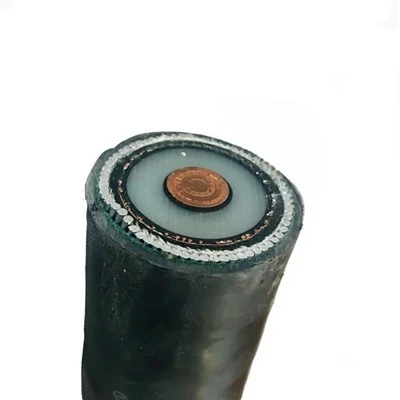
There are also different types of copper core cables that are better suited for high – frequency applications. For example, coaxial cables are a popular choice. A coaxial cable consists of a central copper conductor, surrounded by an insulating layer, and then an outer conducting layer (usually a copper braid or foil). This design helps to contain the electromagnetic field within the cable, reducing radiation losses and improving signal integrity. Twisted – pair cables are another option. By twisting the copper wires together, we can reduce electromagnetic interference and improve the performance of the cable at high frequencies.
But it’s not all rosy. There are some limitations to using copper core cables in high – frequency applications. As the frequency increases, the signal attenuation can become significant. This means that the strength of the signal decreases as it travels along the cable. Also, the cost of high – quality copper core cables designed for high – frequency applications can be relatively high. We need to use high – grade copper, high – performance dielectrics, and follow strict manufacturing processes, all of which add to the cost.
However, when you compare copper core cables with other alternatives like fiber – optic cables, copper still has its advantages. Fiber – optic cables are great for very high – speed, long – distance communication, but they are more fragile and require more complex installation and maintenance. Copper core cables, on the other hand, are more robust, easier to install, and can be a cost – effective solution for many high – frequency applications, especially in shorter distances and within buildings.
So, in conclusion, yes, copper core cables can definitely be used in high – frequency applications. With the right design, construction, and choice of materials, they can provide reliable performance and good signal quality. Whether it’s for radio frequency (RF) systems, high – speed data networks, or other high – frequency applications, copper core cables have a place in the market.
If you’re in the market for copper core cables for your high – frequency applications, I’d love to chat with you. We’ve got a wide range of options available, and we can work with you to find the best solution for your specific needs. Just reach out, and we can start a discussion about your project.
Aluminum Core Cable References:
- "Electromagnetic Field Theory Fundamentals" by Bhag Singh Guru, Hüseyin R. Hiziroglu
- "High – Frequency Electronics Design and Application" by various authors
Hebei Fengbo Electrical Equipment Co., Ltd.
As one of the most professional copper core cable manufacturers and suppliers in China, we warmly welcome you to wholesale durable copper core cable for sale here and get quotation from our factory. All custom made cables are with high quality and competitive price. Also, OEM service is available.
Address: No.100 meters south, East Ring Road & Wei’er Road intersection, Huang’erying East Village, Jiajiakou Town, Ningjin County, Xingtai City, Hebei Province, China
E-mail: fonbocable@gmail.com
WebSite: https://www.fonbocable.com/
